


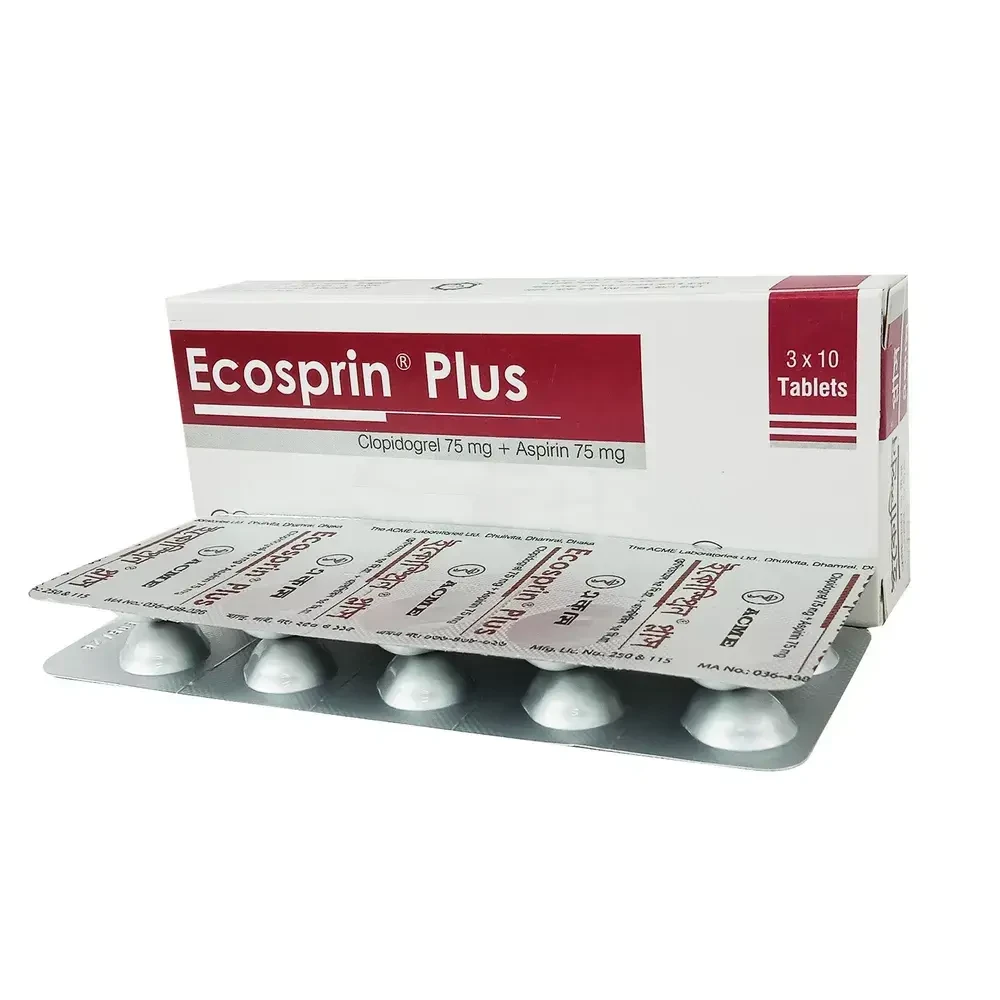



Ecosprin Plus
120.00৳
Indications
Acute Coronary Syndrome (ACS): Ecosprin Plus is indicated to reduce the rate of Myocardial Infarction (MI) and Stroke in patients with non-ST-segment elevation ACS [unstable angina (UA)/non-ST-elevation Myocardial Infarction (NSTEMI)] and acute ST-segment elevation ACS [ST-elevation Myocardial Infarction (STEMI)].
Recent MI, recent Stroke, or established Peripheral Arterial Disease: In patients with established peripheral arterial disease or with a history of recent Myocardial Infarction (MI) or recent Stroke it is indicated to reduce the rate of MI and Stroke.
Pharmacology
Clopidogrel is a prodrug. It inhibits platelet activation and aggregation through the irreversible binding of its active metabolite to the P2Y12 class of ADP receptors on platelets. Dose-dependent inhibition of platelet aggregation can be seen at 2 hours after single oral doses. Repeated doses of 75 mg per day inhibit ADP-induced platelet aggregation on the first day, and inhibition reaches steady state between Day 3 and Day 7.
Aspirin inhibits platelet aggregation by irreversible inhibition of platelet cyclooxygenase and thus inhibiting the generation of thromboxane A2 a powerful inducer of platelet aggregation and vasoconstriction.
Pharmacokinetics: After repeated 75-mg oral doses of Clopidogrel (base), plasma concentrations of the parent compound, which has no platelet inhibiting effect, are very low and are generally below the quantification limit (0.00025 mg/L) beyond 2 hours after dosing. Clopidogrel is extensively metabolized by the liver. The main circulating metabolite is the carboxylic acid derivative, and it has no effect on platelet aggregation. It represents about 85% of the circulating drug-related compounds in plasma. Following an oral dose of 14C-labeled Clopidogrel in humans, approximately 50% is excreted in the urine and approximately 46% in the faeces in the 5 days after dosing. The elimination half-life of the main circulating metabolite is 8 hours after single and repeated administration. Administration of Clopidogrel with meals did not significantly modify the bioavailability of Clopidogrel as assessed by the pharmacokinetics of the main circulating metabolite.
Absorption and Distribution: Clopidogrel is rapidly absorbed after oral administration of repeated doses
of 75 mg Clopidogrel (base), with peak plasma levels (3 mg/L) of the main circulating metabolite occurring approximately 1 hour after dosing. The pharmacokinetics of the main circulating metabolite are linear (plasma concentrations increased in proportion to dose) in the dose range of 50 to 150 mg of Clopidogrel.
Absorption is at least 50% based on urinary excretion of Clopidogrel-related metabolites. Clopidogrel and the main circulating metabolite bind reversibly in vitro to human plasma proteins (98% and 94%, respectively). The binding is nonsaturable in vitro up to a concentration of 100 g/mL.
Metabolism and Elimination: In vitro and in vivo, Clopidogrel undergoes rapid hydrolysis into its carboxylic acid derivative. In plasma and urine, the glucuronide of the carboxylic acid derivative is also observed.
Dosage & Administration
Interaction
Study of specific drug interactions yielded the following results:
Aspirin: Aspirin does not modify the Clopidogrel-mediated inhibition of ADP-induced platelet aggregation. Clopidogrel potentiates the effect of aspirin on collagen-induced platelet aggregation.
Heparin: Clopidogrel does not necessitate modification of the heparin dose or alter the effect of heparin on coagulation. Co-administration of heparin has no effect on inhibition of platelet aggregation induced by Clopidogrel.
Nonsteroidal Anti-Inflammatory Drugs (NSAIDs): Concomitant administration of Clopidogrel is associated with increased occult gastrointestinal blood loss. NSAIDs and Clopidogrel should be co-administered with caution.
Warfarin: The safety of the co-administration of Clopidogrel with warfarin has not been established. Consequently, concomitant administration of these two agents should be undertaken with caution.
Contraindications
Side Effects
Pregnancy & Lactation
Precautions & Warnings
- Ecosprin Plus may prolongs the bleeding time.
- Thrombotic thrombocytopenic purpura (TTP): TTP has been reported rarely following use of Ecosprin Plus.
- Reye’s syndrome: Reye’s syndrome may develop in individuals who have chicken pox, influenza or flu symptoms. Hypersensitivity including rash, angioedema or hematologic reaction has been reported in patients receiving Ecosprin Plus or history of hypersensitivity to other thienopyridines
Use in Special Populations
Overdose Effects
Therapeutic Class
Storage Conditions


Reviews
There are no reviews yet.